EV Companies
Operates across mass-market to ultra-premium EVs through Dynasty, Ocean, Denza, and Yangwang brands. Largest EV manufacturer globally with ~4.27M NEV deliveries in 2024 (BEV+PHEV) and full vertical integration including in-house batteries and chips. Targeting aggressive international expansion across Europe, Southeast Asia, and Latin America while continuing to undercut competitors on price.
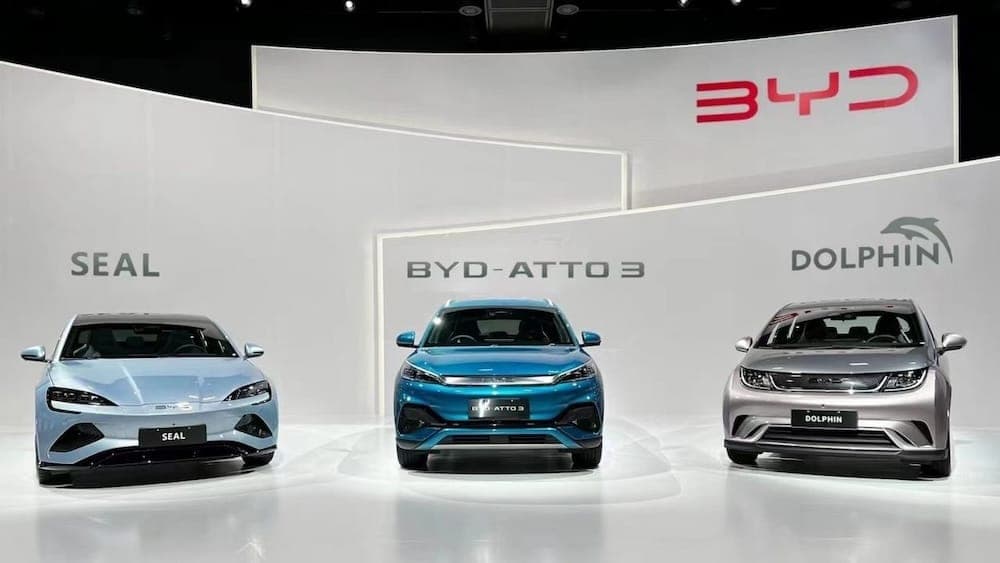
BYD Sales Availability
Product Lineup Timeline
Vehicle Milestones
BYD founded in Shenzhen by Wang Chuanfu as a rechargeable battery maker, supplying Motorola and Nokia. Battery DNA later becomes the strategic moat as BYD pivots to EVs.
BYD acquires struggling Tsinchuan Automobile for ~$31M: Wang's bet that a battery maker is uniquely positioned to build EVs. Skepticism causes BYD shares to drop ~21% in two days, but the move launches BYD's auto business.
Berkshire Hathaway buys 10% stake in BYD for $232M ($1/share equivalent) at Charlie Munger's recommendation: a defining endorsement that elevates BYD globally and ultimately delivers Berkshire >30x returns.
BYD F3DM goes on sale in China: the world's first mass-produced plug-in hybrid passenger vehicle. Limited initial demand but establishes the architectural template for BYD's later DM (Dual Mode) hybrid lineup.
BYD and Daimler launch DENZA JV (50/50) in Shenzhen: first international JV producing premium EVs in China. First DENZA 400 launches 2014; Mercedes exits Dec 2021 and DENZA becomes BYD-controlled premium brand.
Launches the Qin plug-in hybrid, kicking off the Dynasty Series (Qin/Tang/Song/Yuan) of NEVs that would dominate Chinese plug-in sales through the 2020s and seed BYD's volume model strategy.
Unveils the Blade Battery: a long, thin LFP cell-to-pack design that becomes the industry's safety benchmark after passing the nail-penetration test without thermal runaway. Becomes BYD's core IP differentiator.
Han EV launches as the first production vehicle to use the Blade Battery; sub-3-second 0-100 km/h variant elevates BYD's perceived premium credibility and signals the brand can compete with Tesla on performance.
BYD becomes the first major automaker globally to stop producing pure ICE passenger vehicles, focusing exclusively on BEV and PHEV: a defining corporate inflection that cements its NEV-pure-play identity.
BYD reportedly begins supplying Blade Battery cells to Tesla for Model Y production at Gigafactory Berlin: turning rivals into customers and validating Blade as a global-tier cell offering.
Produces 5 millionth NEV; the next 5 million arrive in roughly 15 months as production rate accelerates: by far the fastest scale ramp in EV history.
Inaugurates EV plant in Rayong, Thailand: BYD's first wholly-owned factory outside China with 150,000-unit annual capacity. Anchors BYD's ASEAN export hub strategy under regional FTA terms.
Q3 revenue of 201.12B yuan ($28.24B) overtakes Tesla's quarterly revenue for the first time: a symbolic crossover that reframes BYD as the new global EV financial heavyweight.
BYD overtakes Tesla in global pure-BEV sales for full-year 2024 by Q4 momentum: closing the gap that defined the 2020-2023 EV race and reshaping the EV competitive landscape.
Unveils 'Super e-Platform' with 1,000 kW (1 MW) flash charging: enabling 400 km of range in 5 minutes. Redefines DC fast-charging benchmarks above CATL's Shenxing and Tesla V4 Supercharger.
Brazil passenger-car plant in Camacari (former Ford site) begins operations: $1B investment, 150,000-unit capacity, BYD's first South American factory and a strategic counter to Latin American import duties.
Hungary EV factory in Szeged begins production: BYD's first European plant aimed at sidestepping the EU's 17% punitive tariffs on Chinese-made BYDs while serving the broader European market.


Prefer Sterling in Google
Add sterlingcharts.com as a preferred source so our charts can appear with a preferred badge in Google Top Stories, AI Mode, and AI Overviews.