
Produces CPUs and GPUs for data centers, gaming, and embedded AI, challenging NVIDIA with its Instinct MI series accelerators. ~$25B annual revenue company capturing growing AI data center share with ~8% of the accelerator market. Targeting hyperscaler and enterprise customers with competitive price-performance while expanding its ROCm AI software ecosystem.
Company Profile
NVIDIA's strongest challenger — competing on price-performance with open-source software.
Key Products & Platforms
MI300X
Data Center GPU192GB HBM3, NVIDIA H100 competitor
MI350
Data Center GPUUpcoming next-gen accelerator
EPYC CPUs
Server CPUGained 30%+ data center CPU share
Ryzen AI
PC ProcessorOn-device AI for laptops and desktops
ROCm
Software PlatformOpen-source GPU compute stack
Key Customers
Competitive Position
Market Share
~12% of AI accelerator market, ~33% of server CPUs
Competitive Moat
Competitive pricing, strong CPU+GPU combination, open-source ROCm software
Key Risk
ROCm software ecosystem still trails CUDA; late to market vs NVIDIA
Why This Company Matters
AMD is the main check on NVIDIA's monopoly. As hyperscalers look to diversify GPU suppliers and reduce costs, AMD is the most credible alternative for large-scale AI training.
Key Milestones
Founded May 1 in Sunnyvale, CA by Jerry Sanders and seven Fairchild colleagues with $100K seed; chartered as a second-source maker of logic chips designed by Fairchild and others to undercut prices.
IPO on the NYSE at $15.50/share, raising the capital that funded a Sunnyvale wafer fab and AMD's expansion into bipolar logic and DRAM second-sourcing.
Signed second-source agreement with Intel for the 8080 microprocessor; the deal established the second-source business model that funded AMD through the 1980s.
Released the Am386, a clean-room reverse-engineered Intel 386 clone, after a court battle; the chip undercut Intel pricing by ~50% and forced the era's first true PC CPU price war.
Released Am386DX-40, the highest-clocked 386-class chip; combined with aggressive pricing, AMD captured ~20% of the PC CPU market by 1993.
Acquired NexGen for $857M, gaining the Nx686 core that would become the AMD K6; pivotal step toward an independent x86 micro-architecture rather than reverse-engineered Intel clones.
Launched K6 processor at 166-233MHz, AMD's first competitive x86 against Pentium MMX; gross margins improved sharply and AMD reached ~10% PC CPU share.
Launched Athlon (K7), AMD's first independent x86 microarchitecture; first to ship a 1GHz x86 processor (March 2000), beating Intel by months and ending Intel's clock-speed dominance.
Athlon Thunderbird hit 1GHz March 6, beating Intel Pentium III to the milestone by days; capped a multi-year campaign of clock-rate leadership against Intel.
Launched Opteron (K8), the first 64-bit x86 server CPU with on-die memory controller and HyperTransport; forced Intel to abandon Itanium-only 64-bit strategy and adopt AMD64.
Acquired ATI Technologies for $5.4B (cash + stock); the deal aimed to fuse CPU + GPU into Fusion APUs but loaded AMD with debt and triggered a decade of underperformance.
Spun off manufacturing arm as GlobalFoundries with a $5.7B investment from Mubadala (Abu Dhabi); freed AMD to operate fabless and avoid the cost of node transitions.
Launched first Fusion APU (Llano), integrating CPU + Radeon GPU on a single die five years after the ATI deal; enabled console wins (PS4/Xbox One) but desktop performance disappointed.
Lisa Su appointed CEO October 8, replacing Rory Read; her engineering-first, server-and-AI roadmap (Zen, EPYC, Instinct) would power AMD's 100x stock recovery over the next decade.
Launched Zen 1 (Ryzen 1000 series) March 2 on GlobalFoundries 14nm; jumped Bulldozer's IPC by 52% in one generation and ended Intel's decade-long performance lead.
Launched EPYC server CPUs (codename Naples), AMD's return to data-center after a decade absence; 32 Zen cores and 128 PCIe lanes per socket reset price-performance norms.
Announced $35B all-stock acquisition of Xilinx, the FPGA leader; the deal closed February 2022 and added programmable logic, networking and adaptive SoCs to AMD's portfolio.
Instinct MI200 series launched, first multi-die GPU and the engine of Frontier exascale supercomputer; Frontier became the world's first exascale system in May 2022.
Closed $49B Xilinx acquisition (final value after stock appreciation); CEO Lisa Su gained adaptive SoC, FPGA and SmartNIC IP that powered the MI300 series and AI networking strategy.
MI250X data-center accelerators caught in the October 7 BIS rules restricting AI chip exports to China; AMD MI200-class shipments to Chinese clouds halted alongside NVIDIA.
MI250X-equivalent China chips caught by tightened October 17 export rules covering performance density and HBM; AMD began designing MI308 China-tailored chip alongside NVIDIA.
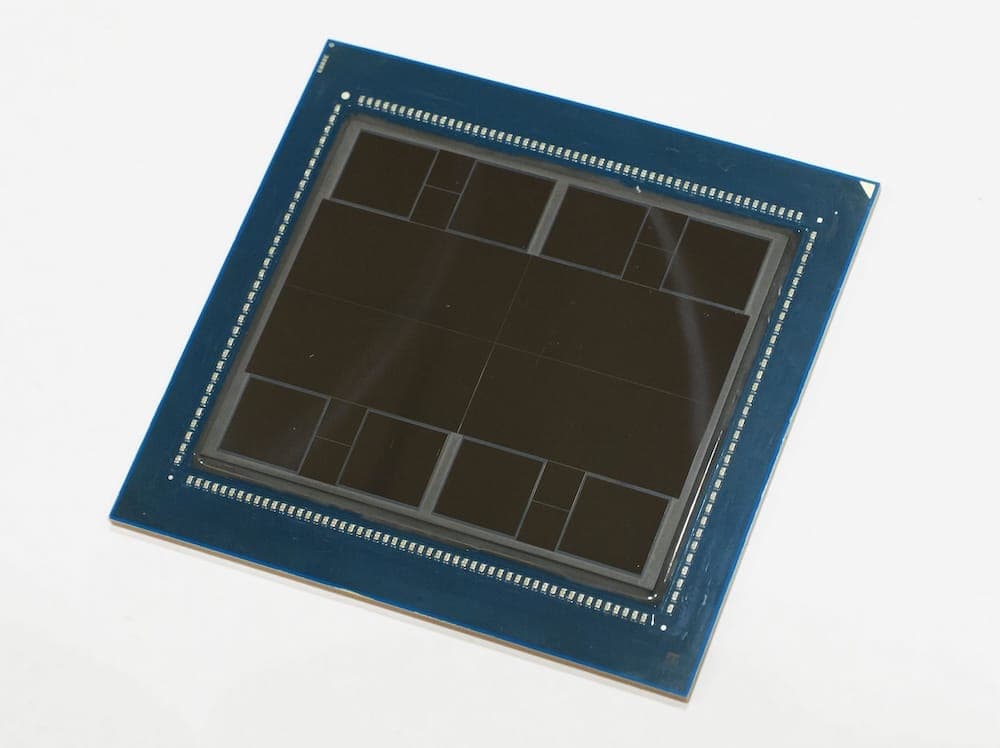
MI300X launched December 6 with 153B transistors and 192GB HBM3, backed by Microsoft, Meta and OpenAI as buyers; MI300X became the first credible alternative to NVIDIA H100 for inference workloads.
MI300A APU launched with integrated CDNA3 GPU and Zen 4 CPU dies, anchoring El Capitan exascale system at Lawrence Livermore; first APU-based Top500 leader and a showcase of chiplet packaging.
MI325X launched October 10 with 256GB HBM3e and 6 TB/s bandwidth on CDNA3, claiming up to 1.3x H200 performance on Llama 3.1 inference; first MI300X refresh.
Disclosed MI355X CDNA4 specs at Advancing AI 2024, targeting 2.3 PFLOPS FP16 and 4.6 PFLOPS FP8 in H2 2025; first AMD GPU on TSMC 3nm.
Reported $5B+ FY2024 data center GPU revenue, vaulting Instinct into a credible second AI training option; Microsoft, Meta and Oracle anchored MI300X deployments.
Took $800M charge on MI308 China-tailored chip after April BIS rule blocked the export design; mirrored NVIDIA H20 inventory write-down on a smaller scale.
Announced full MI350 series at Advancing AI: MI350X air-cooled and MI355X liquid-cooled on 3nm CDNA4; Lisa Su disclosed forward AI revenue forecast of $20B+ for FY2025.
MI308 China shipments resumed alongside NVIDIA H20 after US administration eased AI chip export controls; AMD recovered ~50% of the Q1 charge by year-end.
MI350 series began shipping to partners; MI355X follow-on slated for H2 2025 in liquid-cooled racks for Microsoft and Meta deployments.
MI400 series and Helios rack-scale platform unveiled at CES January 5 by Lisa Su; first GPU on TSMC N2 with HBM4, three SKUs (MI430X/MI440X/MI455X) targeting H2 2026 launch.