
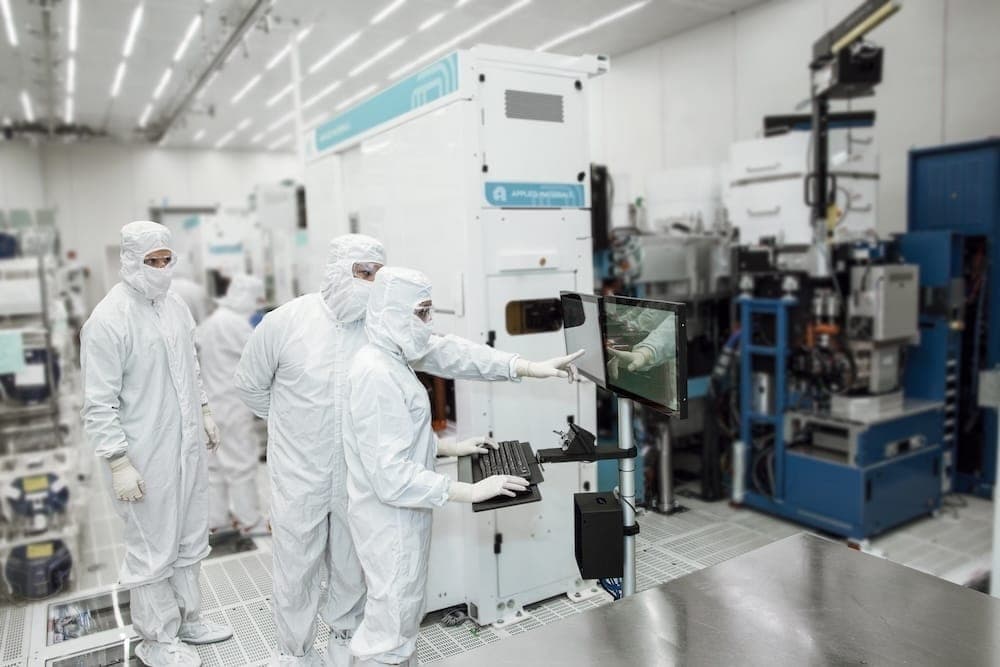
World's largest semiconductor equipment maker providing deposition, etch, and inspection tools essential for chip manufacturing. ~$27B annual revenue company whose equipment is used in virtually every semiconductor fab globally. Benefits from AI-driven capex expansion as chipmakers invest in advanced packaging, Gate-All-Around transistors, and backside power delivery for AI chips.
Company Profile
The picks-and-shovels play of the AI boom — makes the tools used inside every chip factory on earth.
Key Products & Platforms
Endura
Deposition SystemPhysical vapor deposition for metal layers
Producer
CVD SystemChemical vapor deposition tools
Centura
Etch SystemPlasma etch for chip patterning
SEMVision
InspectionDefect detection and review systems
ICAPS
Mature Node ToolsEquipment for IoT, auto, power chips
Key Customers
Competitive Position
Market Share
#1 semiconductor equipment maker overall (~20% of total market)
Competitive Moat
Broadest product portfolio in the industry; present in every fab; deep process co-development
Key Risk
China export restrictions; cyclical capex spending by chipmakers
Why This Company Matters
Applied Materials is the ultimate AI infrastructure play. Every chip factory in the world — from TSMC's cutting-edge fabs to legacy automotive chip plants — uses their equipment. When chipmakers spend billions building new AI capacity, Applied Materials is one of the first to benefit.
Key Milestones
Founded in Mountain View, CA by Michael McNeilly and a group of Fairchild engineers as a maker of vacuum chucks and chemical vapor deposition (CVD) systems for nascent silicon wafer fabs.
IPO on NASDAQ at /share, raising .6M; James C. Morgan joined as president the next year and led Applied for the next four decades to industry leadership.
Released AME 7800 single-wafer plasma etch system; the move from batch to single-wafer processing became the industry template for high-yield semiconductor equipment.
Opened first Japan service center in Narita; Applied became the first US semi equipment company to crack the Japanese market dominated by Tokyo Electron and Hitachi.
Released the Precision 5000 multi-chamber CVD platform; the cluster-tool architecture became the industry standard and powered Applied past Tokyo Electron in revenue.
Acquired Etec Systems for .8B in stock, adding mask-writing equipment for advanced lithography masks; expanded Applied beyond pure deposition/etch into mask shops.
Mike Splinter, ex-Intel, became CEO; pivoted Applied toward solar-cell equipment and ramped M&A to expand outside core wafer-fab tools.
Closed .9B acquisition of Varian Semiconductor November 10, adding ion implantation tools; gave Applied broadest equipment footprint of any single supplier.
Announced B merger of equals with Tokyo Electron September 24; would have created a Netherlands-domiciled equipment giant ahead of ASML.
Abandoned Tokyo Electron merger April 27 after US DOJ opposed deal; announced B buyback as consolation and pivoted growth back toward organic R&D.
Took ~$2.5B FY2023 revenue hit estimate from October 7 BIS rules barring advanced equipment sales to Chinese fabs; pulled all US persons from SMIC, YMTC and ChangXin sites within days.
Announced $4B EPIC R&D center in Sunnyvale, the largest single facility investment in Applied's history; targeted gate-all-around, backside power and 3D packaging research with university partners.
Disclosed DOJ probe over alleged shipments of advanced tools to Chinese SMIC subsidiaries via South Korean intermediary; settlement under negotiation as of mid-2025.
Reported FY2024 advanced packaging revenue tripled to $1.7B, driven by HBM hybrid bonding tools at memory makers; first concrete evidence Applied was capturing AI capex outside core wafer fab.
December 2 BIS update added 24 categories of semiconductor manufacturing equipment to China export controls; AMAT estimated $400M+ FY2025 revenue at risk.
Warned of $400M revenue hit in fiscal 2025 from December 2024 BIS rules tightening China equipment controls; pivoted aggressively into HBM hybrid-bonding tools to offset.