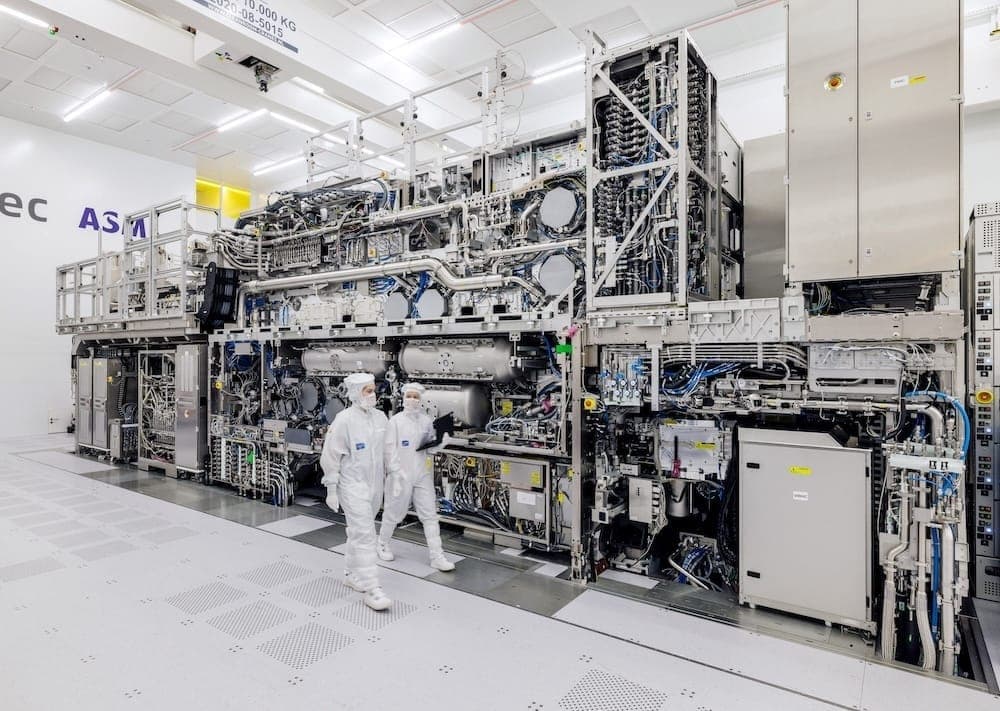
Sole supplier of extreme ultraviolet (EUV) lithography machines required to manufacture the most advanced AI chips. ~$30B annual revenue company with a monopoly on EUV technology used by TSMC, Samsung, and Intel for sub-7nm chip production. Its High-NA EUV systems are critical for next-gen 2nm and below nodes powering future AI processors.
Company Profile
The most irreplaceable company in tech — the sole maker of the machines that print advanced chips.
Key Products & Platforms
EUV (TWINSCAN NXE)
Lithography System~$200M machines, monopoly product
High-NA EUV (EXE)
Next-Gen Lithography~$380M machines for 2nm and below
DUV Systems
Lithography SystemOlder-gen systems for mature nodes
YieldStar / HMI
Metrology & InspectionChip quality measurement tools
Key Customers
Competitive Position
Market Share
100% monopoly on EUV lithography (zero competitors)
Competitive Moat
20+ years and billions in R&D; no alternative exists; export controls give geopolitical leverage
Key Risk
Export restrictions to China limit addressable market; long product cycles
Why This Company Matters
ASML has the most extreme monopoly in all of tech. Every advanced chip — from NVIDIA GPUs to Apple processors — requires ASML's EUV machines. There is no alternative, no second source, no workaround. One Dutch company controls the bottleneck of the entire semiconductor industry.
Key Milestones
Founded April 1 in Veldhoven, Netherlands as a 50-50 joint venture between Philips and ASM International to commercialize Philips' lithography research; initial staff of 31 with a 100M guilder budget.
Shipped first PAS 2000 stepper, a 4-inch wafer system targeted at production fabs; hand-built unit was Europe's challenge to Nikon and Canon's stepper duopoly.
Philips wrote down its ASM Lithography stake to zero amid mounting losses; ASML emerged as a fully independent company under CEO Willem Maris with new outside funding.
IPO on Amsterdam (AEX) and NASDAQ at NLG 27.50; ASML emerged with capital to scale up against Nikon/Canon and pursue 248nm DUV lithography.
Released TWINSCAN dual-stage scanner concept, processing wafers in parallel for higher throughput; the architecture became the industry-standard lithography platform for 25+ years.
Acquired Silicon Valley Group (SVG) for .6B, gaining catadioptric lens design and US lithography presence; consolidated lithography into a three-player race with Nikon and Canon.
Shipped TWINSCAN XT:1400 immersion-DUV system; first water-coupled 193nm lithography, which extended optical scaling to 45nm and paved the way for 28nm-and-below logic.
Customer co-investment program raised 3.85B euros from Intel, TSMC and Samsung in exchange for ~23% combined equity; financed EUV development that came online from 2017.
Closed .5B acquisition of Cymer, gaining the EUV light source; integration was crucial to making 13.5nm wavelength stable enough for production lithography.
Shipped first NXE:3300B EUV pre-production system to TSMC for development; tool was unstable but proved 13.5nm photon source could survive long enough for production-relevant runs.
Shipped first NXE:3400B production EUV scanners, enabling TSMC and Samsung 7nm/5nm volume nodes; throughput initially 125 wafers/hour, climbing to 175+ by 2020.
Net bookings surpassed 7B euros in Q1 amid record EUV demand from TSMC, Samsung and Intel; backlog stretched two years out as foundries raced to deploy 5nm/3nm capacity.
Netherlands announced new export licenses required for advanced DUV (NXT:2000i/2050i/2100i) shipments to China starting September 1; Beijing pulled forward DUV orders ahead of cutoff.
Shipped 200th EUV system milestone, with NXE:3800E refresh boosting throughput to ~220 wafers/hour; cumulative EUV shipments funded 30%+ ASML revenue growth from 2020-2023.
Updated US-aligned BIS rules forced ASML to broaden DUV restrictions to additional Chinese fab customers, including SMIC and CXMT; effective FY24 China revenue forecast cut by ~15%.
Shipped first High-NA EUV (TWINSCAN EXE:5000) modules to Intel's D1X fab in Oregon for sub-2nm logic; tool priced at ~$380M and required two months of on-site assembly per system.
Booked record 9.2B euros in Q4 orders as EUV/High-NA backlog stretched into 2026; full-year 2023 revenue hit 27.6B euros, a 30% YoY increase entirely on AI-driven foundry capex.
Dutch DUV export controls fully in force; ASML lost remaining shipment licenses for top-end immersion tools to China, including NXT:2000i and NXT:2050i for 7nm-class production at SMIC.
Shipped second High-NA EUV (EXE:5200) to TSMC for 2nm/A14 development, broadening High-NA customer base beyond Intel; Samsung order placed for 2026 delivery.