Legacy CPU leader pivoting to AI with Gaudi accelerators, foundry services, and Mobileye autonomous driving chips. $55B annual revenue but losing data center market share while restructuring around AI, foundry, and edge computing. Aims to regain relevance through Intel Foundry Services for third-party chipmaking and its Gaudi/Falcon Shores AI accelerator roadmap.
Company Profile
The former chip king fighting to stay relevant in the AI era with foundry ambitions and new accelerators.
Key Products & Platforms
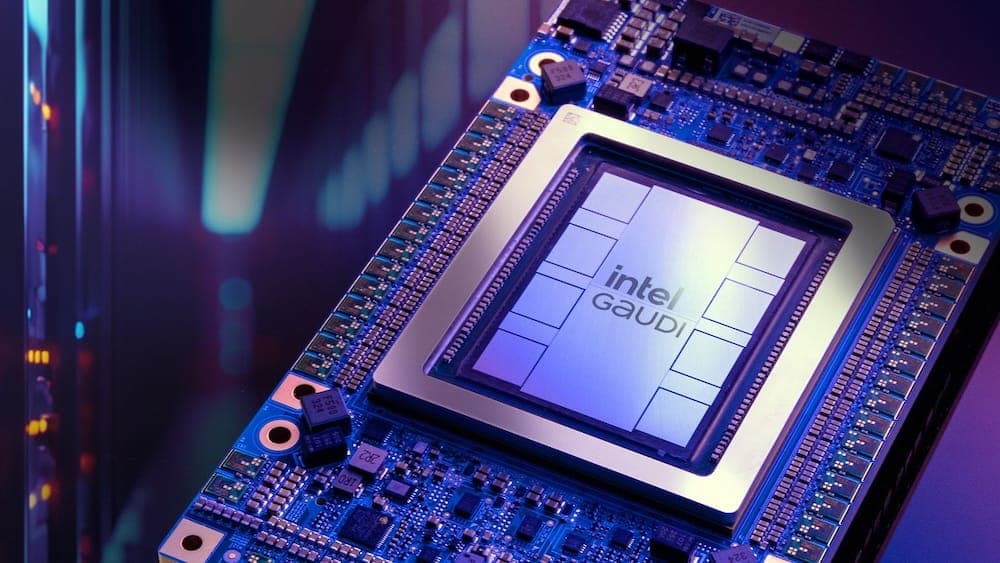
Gaudi 3
AI AcceleratorPrice-competitive inference chip
Falcon Shores
AI AcceleratorUpcoming GPU-based architecture
Xeon CPUs
Server CPUStill dominant in legacy enterprise servers
Intel Foundry
Foundry ServicesBuilding chips for other companies at Intel 18A
Mobileye
Automotive AIADAS vision chips for automakers
Key Customers
Competitive Position
Market Share
~3% of AI accelerator market, ~70% of total server CPUs (declining)
Competitive Moat
Manufacturing scale, government subsidies (CHIPS Act), legacy enterprise relationships
Key Risk
Losing share on every front — CPUs to AMD, GPUs to NVIDIA, foundry to TSMC
Why This Company Matters
Intel is the biggest turnaround story in semis. If their foundry strategy works, they become a U.S.-based alternative to TSMC. If it fails, they risk becoming irrelevant. High stakes for the entire U.S. chip supply chain.
Key Milestones
Founded July 18 in Mountain View, CA by Robert Noyce (Fairchild co-inventor of the IC) and Gordon Moore (author of Moore's Law), with $2.5M seed from Arthur Rock; initial focus on semiconductor memory rather than logic.
Released the Intel 4004, the world's first commercial microprocessor, on November 15 at $200; designed by Federico Faggin for Japanese calculator maker Busicom, this 4-bit, 2,300-transistor chip launched the modern computing industry.
Launched the 8086, Intel's first 16-bit x86 processor; the chip's instruction-set architecture would become the foundation of every PC processor through Pentium, Core and beyond.
IBM selected the Intel 8088 (cost-reduced 8086) for its first PC, launched August 12; the design win locked Intel-x86 into the volume PC ecosystem for the next four decades.
Launched the 80386 (i386), Intel's first 32-bit x86 processor; introduced protected-mode multitasking that enabled Windows NT, Linux and modern operating systems.
Andy Grove and Gordon Moore exited the DRAM market entirely to focus on microprocessors after Japanese memory makers triggered a price collapse; the strategic pivot defined Intel's next 30 years.
Andy Grove succeeded Gordon Moore as CEO, ushering in the “Only the Paranoid Survive” era; under Grove, Intel revenue grew from .9B to B by 1997.
Launched i486, integrating x87 floating-point unit on-die for the first time at 1.2M transistors; powered the early Windows 3.x desktop wave at 25-33MHz.
Launched Pentium (P5), the first superscalar x86 with two integer pipelines; brand-name marketing campaign made 'Intel Inside' a household sticker and underwrote 60%+ gross margins.
Pentium FDIV bug forced a $475M recall after Thomas Nicely identified the floating-point division flaw; first major PR crisis in Intel's microprocessor era and a template for chip recalls.
Pentium II launched on Slot 1 cartridge with L2 cache; consolidated Intel's lead and inaugurated a five-year run of >50% gross margins on the desktop.
Launched Core 2 Duo (Conroe) on 65nm, a clean break from NetBurst that retook the desktop performance crown from AMD Athlon 64; began a 10-year run of Intel CPU dominance.
Launched Atom and entered netbooks/embedded; the low-margin push proved a strategic dead-end as smartphones (Arm-based) ate the mobile-compute opportunity.
CEO Brian Krzanich resigned June 21 over a past consensual relationship that violated Intel's non-fraternization policy; the abrupt exit came as 10nm yields were missing targets.
Disclosed 10nm volume production was slipping into 2019 with yields below target; the misstep ceded leading-edge logic to TSMC for nearly a decade and triggered the Intel Foundry crisis.
Acquired Habana Labs for $2B to bolster data-center AI training/inference (Gaudi, Goya); Habana would become Intel's primary AI accelerator after Nervana acquisition write-down.
Began volume shipments of first 10nm processor (Ice Lake mobile/Sunny Cove cores) two years late; the chip's modest density gain did not stop AMD Ryzen 3000 from taking client share.
Pat Gelsinger returned as CEO after a decade at VMware, tasked with restoring process leadership; targeted aggressive five-node-in-four-years roadmap (Intel 7, 4, 3, 20A, 18A).
Gelsinger unveiled IDM 2.0 at Intel Unleashed event, including Intel Foundry Services and a $20B Arizona Ocotillo fab expansion; signaled a return to manufacturing as a competitive differentiator.
Announced $20B Ohio mega-fab in Licking County, with potential to reach $100B over a decade; first leading-edge fab outside Israel, Oregon and Arizona in Intel's 50-year history.
CHIPS and Science Act signed into law on August 9, unlocking $52.7B in US semiconductor manufacturing incentives; Intel positioned as primary beneficiary alongside TSMC, Samsung, Micron and GlobalFoundries.
Broke ground on Ohio mega-fab in Licking County September 9, with foundry production targeted for 2025 (later slipped to 2026-27 amid foundry losses).
Mobileye spun off via $861M IPO at $17B valuation October 26; Intel retained majority voting control via Class B shares while monetizing the autonomous-driving asset acquired in 2017 for $15.3B.
Intel 4 (EUV-first) entered volume production for Meteor Lake compute tiles in Hillsboro and Leixlip; Intel's first node fully embracing EUV after years of avoiding the technology.
Awarded preliminary $8.5B CHIPS Act direct funding plus up to $11B in loans for Arizona, Ohio, NM and Oregon; the largest single award in the program at the time.
Lost $7B in foundry segment in 2023, disclosed in first standalone IFS financials, intensifying turnaround pressure; Intel pivoted to Intel 18A as the comeback node.
Suspended dividend and announced 15% workforce cut amid widening foundry losses and Q2 $1.6B loss; share price fell ~26% the next day in the worst single-day drop since 1974.
Sold 49% Altera stake to Silver Lake for ~$4.5B, partly funding 18A capex amid foundry losses; Altera valuation reset to ~$8.75B vs $16.7B Intel paid in 2015.
Reported sub-0.4 defects/cm2 on 18A, claiming the node was nearly ready for risk production at the year's end; later reports questioned actual yields at 10% in summer 2025.
Finalized $7.86B CHIPS Act funding November 26, reduced from $8.5B after a $3B Secure Enclave defense contract carve-out; Intel committed to ~$100B in US fab capex through 2030.
Pat Gelsinger forced into retirement December 1 after the board lost confidence in the foundry turnaround pace; David Zinsner and Michelle Johnston Holthaus served as interim co-CEOs.
Posted $16.6B Q3 GAAP loss including foundry write-down, suspending dividend through the turnaround; the worst quarterly loss in Intel's 56-year history.
18A entered risk production at Fab 52 in Arizona, the first US-fabricated leading-edge node since the 2010s; Panther Lake compute tile became the lead 18A product.
Lip-Bu Tan named CEO effective March 18, signaling a pivot toward foundry pragmatism and 14A focus; Tan returned to Intel board after stepping off in August 2024 over strategy disputes.
US government took 10% equity stake in Intel as part of CHIPS Act conditions, unprecedented direct ownership; converted ~$8B of subsidies into common equity at ~$20.47/share.
CEO Lip-Bu Tan delayed 14A risk production to 2028, betting Intel's foundry future on 18A volume execution; signaled a more pragmatic, customer-led roadmap than Gelsinger's IDM 2.0.
Clearwater Forest Xeon 6+ launched on Intel 18A for early adopter cloud customers; first 18A-based server CPU and Intel's strongest claim to leading-edge logic since 2017.