Operational Presence
Mobileye: Autonomous Vehicle Testing
Supplies ADAS vision chips and autonomous driving software to 50+ automakers, dominating the automotive vision processor market. ~$2B annual revenue with ~70% share of ADAS silicon and 150M+ vehicles equipped with its technology worldwide. Developing SuperVision and Chauffeur systems to enable hands-free and eventually driverless capabilities for OEM partners.
Value Chain Position
Chip Design
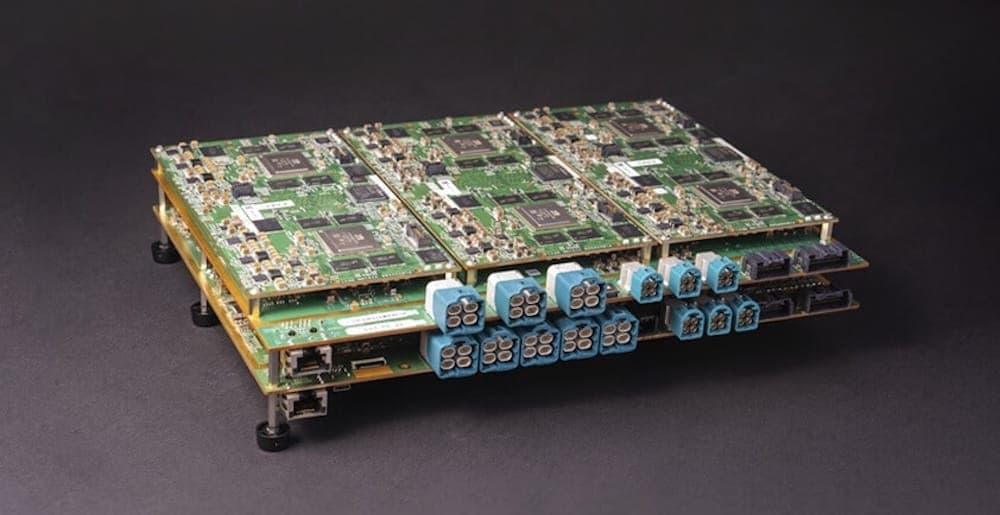
- •EyeQ6: Current-gen ADAS processor delivering 34 TOPS. Powers SuperVision hands-free driving across 50+ automaker partners.
- •EyeQ Ultra: Next-gen L4 autonomous driving SoC with 176 TOPS. Designed to enable full self-driving without human supervision.
Sensors
- •Proprietary Radar: Next-gen imaging radar developed in-house for improved object detection in adverse weather conditions.
- •Silicon Photonics Lidar: FMCW lidar in development using Intel's silicon photonics technology. Targets cost reduction to enable mass-market L4 deployment.
Software / AI
- •SuperVision: Hands-free highway driving system deployed across Zeekr, Polestar, and other OEM partners.
- •Chauffeur: Eyes-off autonomous driving system targeting L4 capability. Uses dual-compute architecture with EyeQ Ultra.
- •REM Mapping: Road Experience Management — crowdsourced HD mapping using data from 150M+ vehicles equipped with Mobileye cameras.
Key Milestones
Founded by Hebrew University Prof. Amnon Shashua with co-founders Ziv Aviram and Norio Ichihashi to commercialize monocular vision ADAS — radical at a time when stereo cameras were considered the only viable approach.
Decision made to design EyeQ — a custom System-on-Chip dedicated to vision-stack compute. Considered radical and risky, this bet became Mobileye's defensive moat and the template for automotive AI silicon for the next 25 years.
First EyeQ1 chips ship to OEMs starting with Volvo, BMW, GM. Single-camera ADAS pioneers monocular vision (lane keep, AEB) at automotive-grade cost — established Mobileye as the default Tier-1 ADAS supplier.
IPO on NYSE Aug 2014 at $5.3B opening valuation — largest Israeli tech IPO at the time. Listed at $25/share, doubled on Day 1.
Ended Tesla partnership two months after the Joshua Brown fatal crash — Mobileye CTO Amnon Shashua publicly criticized Tesla for 'pushing the envelope in terms of safety'. Tesla pivoted to in-house compute (HW2 with NVIDIA, then HW3 in-house).
Intel acquisition closed; Mobileye became Intel's autonomous-driving subsidiary. Shashua promoted to lead Intel's combined AV efforts; Aviram retained operations role.
First production cars start harvesting REM (Road Experience Management) crowdsourced HD-map data via EyeQ4. Differentiator vs Waymo's bespoke HD maps — Mobileye's bet was OEM scale would generate fresher maps cheaper.
EyeQ chip cumulative shipments crossed 100M units — at this point installed in ~1 in 4 ADAS-equipped cars globally. Validated REM crowdsourced mapping thesis.
EyeQ Ultra announced at CES — 176 TOPS L4 chip on TSMC 5nm, first Mobileye chip designed for end-to-end driverless. Production targeted 2025.
IPO at $16.7B valuation — Intel re-listed Mobileye at $21/share Oct 26 2022 (well below 2021 expected $50B). Intel retained ~94% post-listing; began path toward partial divestment for foundry capital.
Chauffeur eyes-off platform announced for Polestar 4 — first Mobileye L3 production deal. Combined Chauffeur software + Mobileye/Luminar lidar for hands-off + eyes-off highway.
Volkswagen Group expanded partnership — Audi/Porsche/Bentley/Lamborghini SuperVision and Chauffeur deals announced. Largest single-OEM win since Mobileye's IPO; cumulative VW Group commitment ~$10B over decade.
SuperVision hands-free driving launched with Zeekr in China and Europe — world's first Mobileye-powered city-level NOA. Used 7 cameras + 5 short-range radars + EyeQ5; differentiated as 'no lidar needed' approach.
EyeQ6 chip volume shipments commenced for SuperVision platform — TSMC 7nm node, 34 TOPS. Replaced EyeQ5 across hands-free OEM programs (Ford, Polestar, Volkswagen Audi).