Operational Presence
Waymo: Robotaxi Operations

Operates commercial robotaxi services using lidar-based L4 autonomy in San Francisco, Phoenix, Los Angeles, and Austin. Completing 150K+ paid rides per week, making it the largest operational robotaxi service in the US. Backed by Alphabet's $2T+ resources and targeting nationwide US expansion with eventual international deployment.
Value Chain Position
Sensors
- •Laser Bear Lidar: Custom-designed lidar sensor built in-house, replacing previous Honeycomb lidar. Offers 360° coverage with improved resolution.
- •Camera & Radar Suite: 29 cameras and 6 radar units per vehicle providing redundant perception across all conditions.
Software / AI
- •Waymo Driver: 5th-generation autonomous driving system with end-to-end perception, prediction, and planning. Trained on billions of miles of real and simulated driving.
Fleet Operations
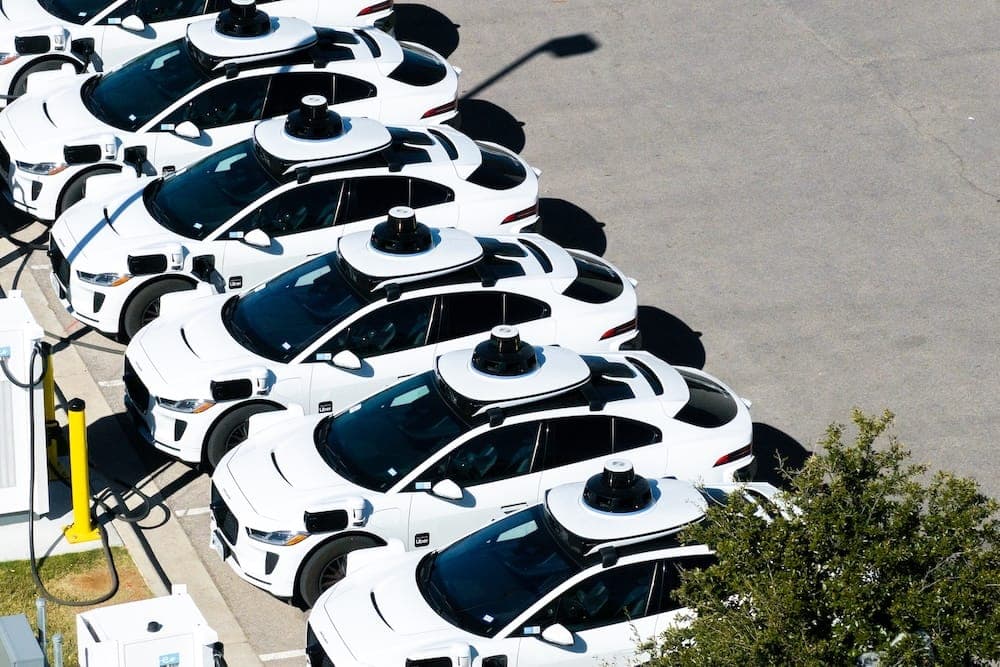
- •Waymo One Fleet: Operates 700+ Jaguar I-PACE robotaxis across 6 US cities. Completing 150K+ paid rides per week with fully driverless operation.
Ride-hail / Logistics
- •Waymo One App: Consumer ride-hailing app for booking fully driverless rides in service areas.
- •Uber Integration: Waymo robotaxis available through the Uber app in Phoenix and Atlanta, expanding the addressable rider base.
Key Milestones
Project Chauffeur (Google self-driving car project) launched Jan 17 2009 inside Google X by Sebastian Thrun (Stanford SAIL/DARPA Grand Challenge) and Anthony Levandowski. Initial team included Chris Urmson and Dmitri Dolgov from CMU — many became future leaders at Waymo, Aurora, Uber ATG.
Fiat Chrysler partnership announced — 100 Pacifica hybrid minivans modified for Project Chauffeur testing. First major automaker integration deal; established the platform that Waymo One would launch on 2 years later.
Project Chauffeur spun out from Google X as Waymo LLC under Alphabet — John Krafcik named CEO. Already $1.1B spent (2009-2015) and over 1M autonomous miles driven. Strategic reset emphasized commercialization timeline.
Early Rider Program launched in Phoenix — invited residents to ride free in safety-driver Pacifica robotaxis in a 100-sq-mi geofence around Chandler. World's first public consumer robotaxi access.
Waymo One commercial robotaxi service opened to public in Phoenix Dec 5 2018 — first paid driverless rides in US (with safety drivers); ~400 vehicles, 50-sq-mi geofence around Chandler. Subscription mostly limited to Early Rider members initially.
Detroit American Axle factory opened — world's first dedicated autonomous-vehicle production facility. Repurposed from Tier-1 manufacturing to integrate Jaguar I-Pace and Pacifica robotaxi platforms.
Fully driverless rides opened to public in Phoenix Oct 8 2020 — no safety driver in Waymo One vehicles for the first time. Major proof point that L4 robotaxis could operate commercially without human backup.
Geely/Zeekr partnership announced — purpose-built sixth-gen Waymo Driver platform on Zeekr-built electric MPV. Multi-year design + manufacturing deal that culminated in 2024 unveiling.
San Francisco driverless commercial service opened to public Aug 2023 — Waymo's second commercial city after Phoenix. Initial daytime restrictions lifted; geofence covered ~50% of SF.
Austin and Atlanta launches via Uber app + LA partial public access; 50K weekly rides milestone (later 150K by Q4). Acceleration after Cruise's exit cleared the SF/LA market for Waymo dominance.
Closed $5.6B Series C led by Alphabet at ~$45B valuation — funded LA, Austin, Atlanta expansions. Largest AV funding round of 2024.
Sixth-generation Waymo Driver unveiled on Zeekr RT — 13 cameras, 4 lidars, 6 radars; Hyundai Ioniq 5 also confirmed as second platform. Cost target $30K (down from prior gen ~$100K).
Public Los Angeles launch — anyone can hail via Waymo app in 80-sq-mi LA service area. Removed waitlist after 3 months of paid pilot operations.
Surpassed 200M cumulative autonomous miles across robotaxi fleet — fully driverless miles alone passed 50M, the most of any L4 operator globally.
Austin public launch via Uber app — first city Waymo operates only through partner app (no Waymo One app). Tested orchestration model that Uber claimed as proof of platform value.
Crossed 450K weekly paid rides; 14M trips in 2025; 20M+ lifetime. Operations in Phoenix, SF, LA, Austin, Atlanta. Largest commercial L4 service globally by paid rides.
Limited driverless rides launched in Miami; Tokyo testing fleet expanded — first non-North American Waymo testing operations. Initial Miami fleet ~30 vehicles in 25-sq-mi geofence.
Raised $16B at $126B valuation Feb 2 2026 to fund London, Tokyo, and 20+ new US cities (Dallas, Denver, Detroit, Houston, Las Vegas, Nashville, Orlando, San Antonio, San Diego, DC). Dragoneer/DST/Sequoia led; Andreessen Horowitz, Mubadala, Bessemer, Silver Lake, Tiger Global, T Rowe Price participated.